Force Matrix MLM Plan
A fixed-width, fixed-depth structure (such as 3x3 or 5x7) with automatic spillover — easy to visualise and popular for bundled entry packages.
- Fixed width and depth (e.g. 3×3) — the frontline is capped and extra recruits spill over.
- Pays level commission per depth plus a bonus when the matrix completes.
- Popular for low-cost, bundled entry packages.
How it works
Every distributor's frontline is capped at a fixed number of positions (the "width") and the matrix only counts a fixed number of levels deep. Once a distributor's frontline is full, additional recruits spill over into open positions further down the matrix — including under other distributors.
- Every distributor's frontline is capped at a fixed width (e.g. 3 or 5) — no more positions can be added once it's full.
- The matrix also has a fixed depth — only a set number of levels count for commission.
- Once a distributor's own frontline is full, additional recruits — theirs or their upline's — spill over into the next open position, which may be under someone else entirely.
- As positions fill level by level, commission is paid on volume passing through, and a completed matrix often triggers a cycle bonus or automatic re-entry into a new one.
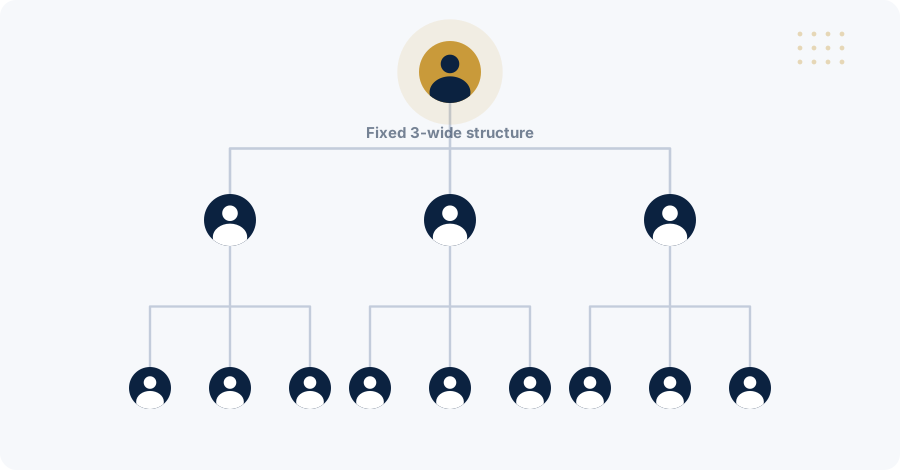
Fixed width, unlimited spillover
A matrix plan trades away Unilevel's unlimited width for a fixed, predictable shape — everyone knows exactly how many positions exist at each depth. The tradeoff is that almost every position beyond your own frontline fills through spillover rather than your own recruiting, so your earnings depend heavily on how actively your upline and sideline are recruiting, not just your own effort.
A worked example
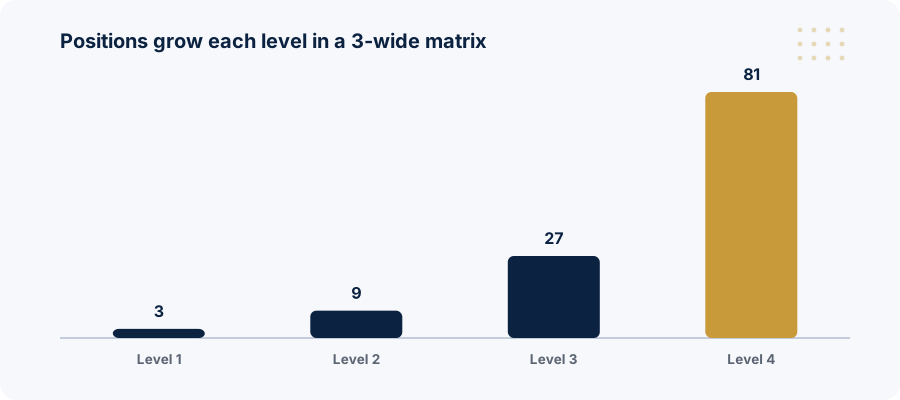
In a 3-wide matrix, Level 1 has 3 positions, Level 2 has 9 (3²), and Level 3 has 27 (3³). If each position is sold as an RM150 entry package and the plan pays 8% per level, a fully filled Level 3 alone generates 27 × RM150 × 8% = RM324 — on top of whatever Levels 1 and 2 contributed. A completed matrix commonly triggers a fixed cycle bonus and can automatically re-enter the distributor into a brand new matrix.
Typical bonus types
- Level commission — a percentage of volume at each matrix depth.
- Matrix completion / cycle bonus — a fixed bonus paid when every position in the matrix fills.
- Re-entry — a completed matrix can automatically re-enter the distributor into a new one.
- Spillover placement bonus — some plans pay a small bonus to whoever "feeds" a spillover placement.
- Rank / leadership bonus — for distributors managing multiple active matrices.
Pros and cons
Pros
- ✓Fixed, predictable structure that's easy to visualise as a grid.
- ✓Spillover means distributors can benefit from the wider network's recruiting, not just their own.
- ✓Cycle and re-entry bonuses reward sustained activity, not just one-time recruiting.
- ✓Works well for low-cost, bundled entry packages.
Cons
- ✕Fixed width means you can't grow your own frontline past the matrix's own limit.
- ✕Heavily dependent on upline/sideline activity — a quiet network fills matrices slowly.
- ✕Spillover placement rules need to be transparent or they create disputes over "who got the good position."
- ✕Re-entry cycles can be difficult for distributors to track without good back-office reporting.
How it compares to other plans
| Plan | Frontline width | Spillover | Best suited to |
|---|---|---|---|
| Unilevel | Unlimited | No | First-time, easy-to-explain plans |
| Binary | 2 legs | Yes | Fast, recruitment-driven growth |
| Force Matrix | Fixed (e.g. 3) | Yes | Bundled, low-cost entry packages |
| Breakaway | Unlimited | No | Leadership-heavy organisations |
Why companies choose it
The fixed structure is simple to display to distributors as a visual grid, and spillover means new distributors can benefit from network-wide recruitment rather than only their own effort — a common design for lower-cost, bundled product entry points.
What to configure
Matrix width and depth (e.g. 3×3, 5×5, 5×7), spillover rules, and re-entry/cycle logic are configured to match your entry package pricing and target growth rate. Want to see the numbers for your own width and depth? Try the commission calculator.
Common questions about the Force Matrix plan
It means every distributor's frontline is capped at a set number of positions — commonly 3, 5, or another fixed number — unlike Unilevel where frontline width is unlimited.
Yes. Once a distributor's frontline is full, additional recruits — theirs or their upline's — spill over into the next open position, which may end up under someone else entirely.
A fully filled matrix commonly triggers a fixed completion or cycle bonus, and many plans automatically re-enter the distributor into a brand new matrix.
Typically as a percentage of the total entry value at that depth — positions filled at that level, multiplied by the entry price, multiplied by the level's commission rate.
Force Matrix has a fixed width that can be more than two (e.g. 3 or 5) and a fixed depth. Binary always has exactly two legs and pays via volume pairing rather than a flat percentage per level.
In plans with re-entry, yes — completing one matrix can enrol the distributor into a new one, effectively running multiple matrices over time.
See it configured for your compensation plan
We'll walk you through how this fits with the rest of the platform.
Get in Touch